
Specialist oral-surgery-led tongue-tie assessment and treatment for newborn babies, children, teenagers and adults is available at our practice in Guildford with a leading surgeon, Dr Ashana Gupta and Tongue Tie Surrey.
From £440: Assessment, treatment & support.
Book a tongue-tie consultation
Fairlands Dental is pleased to offer a specialist tongue-tie service in Guildford under the Tongue Tie Surrey umbrella.
The service is led by Miss Ashana Gupta, Specialist Oral Surgeon, who has a specialist interest in paediatric oral surgery, neonatal tongue-tie and infant feeding.
The service provides assessment and treatment for patients with suspected tongue-tie, with particular emphasis on understanding how tongue movement and oral function may affect an individual patient.
A tongue-tie is not diagnosed by appearance alone. Assessment considers the individual’s anatomy, tongue movement, symptoms, functional difficulties and relevant clinical history.
For further information about the wider Tongue Tie Surrey service, please visit Tongue Tie Surrey.
Specialist oral surgeon: Your assessment and treatment are provided by a Specialist Oral Surgeon with a particular interest in paediatric oral surgery, neonatal tongue-tie and infant feeding.
Function-focused assessment: We consider tongue movement and function alongside anatomy, symptoms and clinical history rather than relying on appearance alone.
Laser treatment: Laser tongue-tie release is available for newborn babies up to 12 weeks old and for patients aged 7 years and above, where clinically appropriate.
Infant-feeding support: Feeding support can be incorporated into the care pathway, including access to appropriately qualified lactation and infant-feeding professionals.
We provide assessment and, where clinically indicated, tongue-tie release for newborn babies up to 12 weeks of age.
Feeding difficulties can have many causes. A thorough assessment is therefore important before deciding whether frenotomy is appropriate.
Our assessment considers the baby’s oral anatomy, tongue movement, feeding history and reported difficulties. Where appropriate, families can also receive infant-feeding support from an appropriately qualified lactation professional.
Where release is clinically indicated, laser treatment may be offered. The choice of technique is discussed with parents as part of the consent process.
Parents are encouraged to ask questions and discuss alternative options before deciding whether to proceed.
Tongue-tie release from 7 years of age
We also provide tongue-tie assessment and release for children aged 7 years and above, teenagers and adults.
For older children and adults, the assessment focuses on whether restriction of tongue movement is associated with relevant functional concerns and whether treatment is likely to provide meaningful benefit.
Treatment can be carried out under local anaesthetic. For suitable younger patients, inhalation sedation may also be considered to help with anxiety and cooperation. Laser release is available where clinically appropriate.
Tongue-tie and feeding difficulties can be complex, and not every feeding difficulty is caused by tongue-tie.
Where appropriate, our service can work alongside appropriately qualified infant-feeding professionals, including IBCLC-qualified lactation consultants, to support families before and after treatment.
This multidisciplinary approach aims to ensure that parents receive feeding support alongside, rather than instead of, appropriate clinical assessment.
Tongue-tie release – From £440
The treatment fee may include the procedure and relevant infant-feeding advice and postoperative support. The exact fee will depend on the patient’s individual clinical needs and treatment pathway.
A personalised treatment plan and costs will be discussed before treatment is undertaken.
Tongue-tie release is a surgical procedure and, as with any procedure, there are potential risks and limitations.
These may include pain, bleeding, swelling, infection, scarring, delayed healing, altered sensation and the possibility that symptoms or functional difficulties may persist following treatment.
Rare complications can occur. These will be discussed during your consultation so that you can make an informed decision about whether treatment is appropriate.
Frenotomy is not appropriate for every patient with a visible lingual frenulum or restricted tongue appearance. Assessment is therefore an important part of the treatment process.
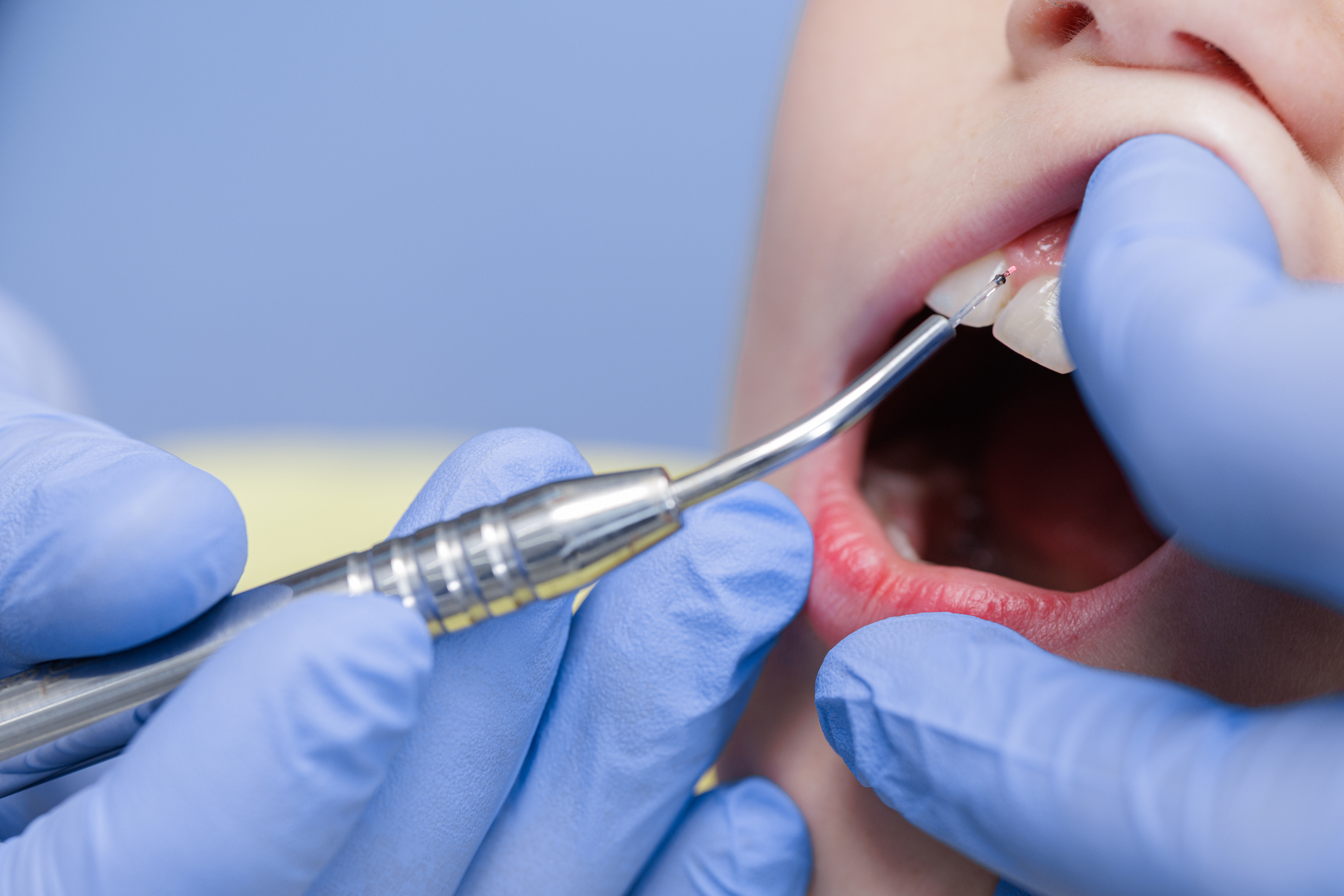 Frenectomies
A frenectomy is simply the removal of a frenum in the mouth. A frenum is a muscular attachment between two tissues. There are two frena (the plural form of frenum) in the mouth that can sometimes obstruct normal function and are candidates for frenectomies. These frena are called the lingual frenum, which connects the tongue to the floor of the mouth, and the maxillary labial frenum, which connects the inside of your upper lip to your gums just above your upper two front teeth.
The Frenectomy procedure is a simple surgical procedure that generally takes less than thirty minutes to complete. The procedure is performed using local anaesthesia, sometimes with intravenous sedation as well.
Frenectomies will usually take a couple of weeks to completely heal. You may have to take over-the-counter drugs like Ibuprofen to relieve any pain that you may have. You should rinse with saltwater or an antiseptic mouthwash such as Chlorhexidine mouthwash in order to keep the surgical area clean. You should brush carefully around the area and floss daily as well.
If you have had a frenectomy using a scalpel, you will have resorbable sutures which should disappear by themselves within a couple of weeks. You should go back to see your dentist after two weeks to remove any sutures that have not resorbed and for us to check that you are healing well.
We offer assessment and tongue-tie release for newborn babies up to 12 weeks of age where clinically appropriate.
Yes. Laser tongue-tie release is available for newborn babies up to 12 weeks old and for patients aged 7 years and above, where clinically appropriate.
Yes. We provide assessment and treatment for children aged 7 years and above, teenagers and adults.
Feeding support can form part of the care pathway. Where appropriate, families may be supported by appropriately qualified lactation and infant-feeding professionals, including IBCLC-qualified lactation consultants.
No. A visible or prominent frenulum does not automatically mean that treatment is required. The decision to recommend release is based on an individual clinical assessment, including relevant functional concerns.
Treatment is available from £440. The exact cost will depend on the individual treatment plan and will be explained before treatment.
Potential frenectomy risks include standard surgical side effects like pain, swelling, bruising, bleeding, and scarring. If ineffective, a repeat procedure may be needed, more commonly for lingual frenectomies than labial ones. Additionally, there is a risk of nerve damage causing temporary tingling or numbness that usually resolves within a few weeks, though permanent loss of sensation occurs on rare occasions.

“Thank you so much for my beautiful new teeth. I cannot begin to express adequately how deeply thrilled I am with them.” A.W.
view more testimonials »
“Many thanks, again, for dealing with me in such a cordial and considerate manner.”
L.T.
view more testimonials »
“The problem with my deeply relishing the joy of my new teeth is that there has been a consequent urge to share some of the wondrous reactions to them with you.”
L.E.
view more testimonials »
“Many thanks, I do hope that your work gives you as much satisfaction and pleasure as it gives your patients.”
R.D.
view more testimonials »
“With a Million x Thank You’s for everything, and wishing you all the continuing success and happiness.”
A.C.
view more testimonials »



We have been successfully placing and restoring dental implants for many years, enabling patients to smile with confidence.

Today, how you look is more a matter of choice than genes and it is no different when considering your choice of smile.

At Fairlands Dental and Implant Centre we offer a wide range of Orthodontic treatments, providing treatments to people of all ages.

Whitening is a process where the tooth discolouration is 'whitened' to a lighter shade. It removes the staining agent through chemical means.

As dentists with an interest in treating dental phobics, it is essential that we treat you, the patient as an individual and customise your treatment to your specific needs.

At Fairlands Dental And Implant Centre we offer a range of anti-wrinkle and facial rejuvenation treatments.

 01483 233 823
 info@fairlandsdental.co.uk


Site last updated
Designed & managed by Dental Design | Read our patient reviews on DentistFinder.net | Privacy Policy | Emergency Information


